
In Memory of Dr. Philip Pit Wang Wong

|
♦ Obituary (by Professor Patrick T.W. Ng) ♦ Tributes ♦ Photo Album |
Obituary: Dr. Philip Pit Wang Wong (1953–2025)
Dr. Philip Pit Wang Wong (王必弘) passed away on Saturday, July 19, 2025, at Queen Mary Hospital at the age of 71 following a battle with cancer.
After graduating from La Salle College, Dr. Wong began his academic journey in the United States in 1971, where he earned his A.B. from the University of Chicago in 1975, followed by an M.A. from Columbia University in 1976 and a Ph.D. from Columbia in 1981. His doctoral thesis, supervised by Professor Masatake Kuranishi, focused on the geometry and analysis of weakly pseudoconvex hypersurfaces in complex spaces. Wong developed innovative methods to study the Moser normal form for such hypersurfaces, demonstrating that a change of coordinates could transform them into a strictly pseudoconvex domain under certain conditions. His work extended to isolated points where the Levi form vanishes, introducing formal power series to map hypersurfaces into normal forms. Theses main results of his thesis were then published in the prestigious journal Inventiones Mathematicae in 1982. Letters from his Columbia mentors, including Professors Lipman Bers, Masatake Kuranishi, and Nancy K. Stanton, praised his technical prowess, creativity, and ability to tackle challenging problems in real analytic hypersurfaces, noting his potential as a researcher and teacher.
On 1st September 1981, Dr. Wong joined the Department of Mathematics at The University of Hong Kong (HKU) as a Lecturer (equivalent to Assistant Professor) and the appointment was substantiated in 1984.
Dr. Wong's research at HKU spanned complex, algebraic, and finite geometry. During a study leave at Columbia University from July 1986 to June 1987, Dr. Wong started to investigate the famous Jacobian conjecture (which says that a polynomial mapping between complex n-dimensional spaces with a nowhere-zero constant Jacobian is invertible) through some discussions with Professor Hyman Bass and he has made progress on the two-dimensional case and special higher-degree scenarios. During another study leave from July 1996 to January 1997 at the University of Notre Dame, Dr. Wong started to work with his elder brother, the late Professor Pit-Mann Wong (1948-2010) on algebraic geometry and value distribution theory, in particular on hyperbolicity. Funded by an RGC grant, they later published four papers in this area (one of them is a joint paper with Dr. Wong’s M.Phil. student Dr. Hiu-Fai Law) from 2005 to 2009.
Dr. Wong was introduced to the subject of Finite Geometry through the co-teaching of the course Sc511 (Development of Mathematical Ideas) by his colleague Prof. Man Keung Siu in 1997. Since then, Dr. Wong has attracted quite a number of final year undergraduate students to his research group on finite geometry. These students include Dr. Kei Yuen Chan, Dr. Alice Man Wa Hui, Dr. Hiu-Fai Law, Dr. Anna Ying Pun and Dr. Yee Ka Tai who have published nine joint papers with Dr. Wong for the period 2008-2015. Notable publications funded by two RGc grants include a paper on the autotopism group of commutative Dickson semifields which completes partial results by R. Sandler from 1962 (Innov. Incidence Geom., 2015), two papers on finite Dickson semifield planes (J. Geom., 2012 and 2015), a geometric proof of a theorem on antiregularity of generalized quadrangles (Des. Codes Cryptogr.,2012) and results on embedding unitary block designs as polar unitals (J. Combinatorial Theory Ser. A, 2013). During the period 2004-2015, Dr. Wong has supervised three M.Phil. students (Hiu-Fai Law(2006), Chung Ching Cheung(2011) and Anna Ying Pun(2011)) and two PhD students (Alice Man Wa Hui(2014) and Yee Ka Tai(2015).
As an educator at HKU, Dr. Wong was admired for his clarity and engagement in teaching. He taught courses in differential geometry, geometric topology and related fields, inspiring students with pertinent questions and quiet persistence. His enthusiasm in mentoring undergraduate and postgraduate students has contributed a lot to the department's intellectual life. in addition, in the early 90s, Dr. Wong was also involved in translating, editing and consulting of five Japanese primary school mathematics into Chinese and English.
Beyond his academic achievements, Dr. Wong led a rich personal life filled with diverse interests and strong family bonds. An avid swimmer, he was a key member of the "HKU Mathematics Department Swimming Team," where he formed lasting friendships, notably with colleagues Prof. Man Keung Siu and Dr. Wai Shun Cheung, sharing daily swims and thoughtful conversations. Later, he excelled in competitive swimming, participating in regional competitions and expeditions that showcased his remarkable stamina. Dr Wong was a dedicated family man, he is survived by his wife, children and grandchildren.
Dr. Philip Pit Wang Wong will be remembered by colleagues, students, and the mathematical community for his lifelong commitment to teaching, mentoring and research during his long tenure (1981-2014) at The University of Hong Kong.
Tuen Wai NG
Professor
Department of Mathematics, HKU
September 9, 2025
Tributes
In memory of Dr. Philip P.W. Wong, my colleague and friend
Philip had been my colleague and friend for forty-four years. Since Philip loved to quote from Confucius’ Analects [論語], let me express my indebtedness to his friendship by quoting the same. Confucius said in the chapter of Jishi [季氏], “友直, 友諒, 友多聞, 益矣. [Friendship with the upright; friendship with the sincere; and friendship with the man of much observation ̶ these are advantageous.])” [1]. Philip was exemplary in all three categories. He was always frank and sharp, offering critical remarks and wise advice at the right moment to benefit and improve me. Together with Sydney Chu Chun Keung and myself we are three Columbians in the Department. Spending our graduate student days at the same university alone cannot convincingly explain why Philip and I immediately became good friends when we first met, since I already left Columbia University a few years before Philip arrived there, and we worked in different areas of research as graduate students. It is rather a commonly shared regard for teaching and learning and a common interest in nurturing the younger generation that had drawn us closer. It is also the personality and quality of Philip which immediately made me feel that we talk on the same frequency.
Soon after joining the Department in 1981 Philip became a companion in our daily swim before lunch. He left the “HKU Mathematics Department Swimming Team [泳隊]” [2] when he moved to reside in Kowloon and had to take up the fatherly duty of transportation of his two daughters to and from school. The Wong’s are dedicated and caring parents. No wonder their two daughters are brought up to be fine young ladies with high achievement as eminent physician and scientist now living abroad. After several years when his daughters could go to school by themselves, Philip came back to the “team”, which was reduced to the two of us by the late 1990s. Philip was a staunch supporter of the “team” and jokingly said that he joined me only because he wanted to serve as my chauffeur [車伕]! Indeed, I was very grateful for the ride, because in those five-and-half years as the Head of Department I badly needed that pleasant hour at the swimming pool every day for relaxation, not to mention the beneficial conversation with Philip during the ride and over lunch — thank you, Philip!

In a way I initiated Philip into regular swimming. He surpassed me in becoming a professional swimmer. Around 2000 he joined a genuine swimming team “Great Current Club [巨流社]” formed by some lifeguards of HKU. Later he joined an even more professional team trained by a former athlete of the Chinese national team [國家隊]. Philip participated in all local and regional competitions to sweep the board. I still remember vividly the day after his first competition Philip walked into my office, beaming with pride and pleasure, with three medals including a gold medal hung around his neck! Later, after retirement he started a new venture in cycling, beginning as a novice to becoming an accomplished cyclist who joined in cycling expeditions outside of Hong Kong which test both mental and physical endurance. I admire his stamina. Philip practiced faithfully what he believed in and what he kept on advising me, namely, “get out of your comfort zone!”
It seems that whatever I initiated Philip into he by far surpassed me. The next example is on academic research. I am very happy to have played a tiny part in it, but at the same time wish I had done it earlier for my own benefit. During our chatting at the poolside and over lunch I often tried to lure Philip into working on problems in discrete mathematics. He said that finite problems would not interest him that much as they could be solved by exhaustive search with a giant computer. He might have a point, but I should have tried harder to convince him that this is only a small part of the picture. We are curious to find a good explanation which makes us feel that we understand the situation better. A good opportunity came up in 1997 when I needed a partner for teaching the course Sc511 (Development of Mathematical Ideas). I invited Philip to do it. I spent the first semester in talking about geometry, from Euclid’s Elements in the third century B.C.E. to the development of non-Euclidean geometries in the nineteenth century. I suggested that he continued in the second semester with projective geometry. A very nice textbook newly published at the time was Projective Geometry and Modern Algebra by Lars Kadison and Matthias Kromann [3].
Later he offered undergraduate projects on orthogonal Latin squares related to finite projective planes. I knew that he finally got interested in the subject [4]. Law Hiu Fai, then a final-year student, took the project with him in 2003. In 2004 Hiu Fai became an MPhil student with Philip and me as co-supervisors. It began with a weekly seminar with only the three of us engaged in it, always in an intense way yet not without humorous remarks thrown in from time to time to boost up everybody’s morale. We all enjoyed this weekly seminar and worked hard at it. It happened that we bumped into a not-so-well-known paper [5] by the well-known mathematician Richard Hubert Bruck (1914 - 1991) of University of Wisconsin at Madison, best known for his work in the field of algebra, especially in its relation to projective geometry and combinatorics. Even though another expert in this field, Heinz Peter Dembowski (1928 – 1971), considered Bruck’s approach in the paper to be ad-hoc, Philip saw in it a geometric significance of foliation structure of a cyclic plane of square order. Hiu Fai’s thesis is to “utilize to the fullest this foliation structure to develop a geometric-numerical method by which we can recapture Bruck’s results in a canonical fashion”. He succeeded in extending Bruck’s results to construct a cyclic plane of order 121 from that of order 11. It was opportune that around that period a French fellow researcher wrote to me about a conference on combinatorics and coding he would organize (of all places, to be held in the beautiful and exotic Tahiti of French Polynesia!). I urged Philip and Hiu Fai to present this piece of work at the conference, which they did and established contact with the research community in that area. This venture, though rather crude and primitive at the beginning stage, turned out to be the starting point of a very fruitful research journey that gained for the "Wong's School [王家班]" (aka “Wong’s corps [王家軍]”) within a decade a prominent position in the international community of finite geometries, when Philip and his team of graduate students produced a series of a dozen very good papers published in some top journals. They presented their findings at several subsequent international conferences, literally catching the research community of finite geometries by surprise.
I am fortunate to have shared part of this exciting journey for a number of years until the team moved on to the greener pasture of ovals and unitals, by which time I fell too far behind and could no longer catch up. But I do relish those lively and intense working seminars on finite geometries that were held every week. This series of weekly seminar that went on continually for a decade surely set a record in the HKU Department of Mathematics! During those years I witnessed Philip's dedicated guidance and significant influence on members of the "Wong's School" at close range. No doubt Philip was a demanding and strict supervisor who pushed his graduate students hard in order to draw the best from them, but he also, deep in his heart, cared for their nurturing and progress. Many times, I witnessed how he patiently worked with his graduate students by going through their submitted drafts carefully and showed them what writing a mathematical paper means. His students might not like it at the time, but all recounted later how much they felt indebted to his instruction, in particular his two doctoral students Alice Hui Man Wa and Tai Yee Ka. Other than the small circle of his graduate students, not too many knew what an excellent thesis supervisor Philip was; otherwise, he would have been awarded an Outstanding Research Student Supervisor Award, which he more than deserved.
What most impresses me is Philip’s geometric insight. He brought a geometric viewpoint to bear on the field and breathed new life into this research area, in particular to the Prime Power Conjecture that has withstood the effort of numerous mathematicians for over eighty years — that any finite projective plane is of order the power of a prime. This is eye-opening for me. In the past I studied such problems only in their combinatorial and algebraic aspects. Thus, I learnt a lot from him. How I wish I had drawn him into my area of research years before 2004. If I had him as a collaborator in the 1980s and 1990s, I might have solved a number of the problems that remain mysterious to me to this date!
In the Fields Lecture of 2000 Michael Atiyah (1929 - 2019) said, “Therefore, spatial intuition or spatial perception is an enormously powerful tool, and that is why geometry is actually such a powerful part of mathematics — not only for things that are obviously geometrical, but even for things that are not.” [6] Philip was a true exemplification of this statement.
In the days before the pandemic Philip used to have lunch with my wife Fung Kit and me, and Chan Yat Ming too, a younger colleague at the Department, almost every weekday at the old Senior Common Room Canteen, usually with coffee/tea and apple pie afterwards plus a leisure chat filled with laughter. For us, especially after Fung Kit went through an operation in the summer of 2018, these somewhat regular lunch gatherings meant relaxation and friendly rapport. This pleasant gathering was brought to a halt by the pandemic so that we have not met for quite some time, except for an occasional email (since I do not carry a cell phone). In February of last year, when a former student Anna Pun Ying came back for a home visit, I organized a lunch gathering and asked Philip to join in. That was the first time I met him again after a lapse of almost four years. At the time I sensed something wrong with him. He did not look as cheerful and as buoyant as usual, and upon seeing me he responded to my asking him how he was doing by reciting part of a poem by the Tang poet 杜甫 [Du Fu]: “名豈文章著? 官應老病休. 飄飄何所似? 天地一沙鷗. [Will fame ever come to a man of letters? Old, ill, retired, no official life betters? What do I look like, drifting on so free? A wild gull seeking shelter on the sea.]" [7] Since he did not elaborate further, I would not press him to say more. Yet from what he occasionally revealed to me, I knew that he was under some kind of medical treatment.
One year later, in February of this year we ran into Philip at Queen Mary Hospital incidentally. As Fung Kit is a cancer patient who needs to visit the hospital for regular target therapy treatment, one morning in the lift going up to the Cancer Day Centre Ward K6 somebody called me. I could barely recognize him except for his voice, because he had a mask and baseball cap on. He was Philip, who looked definitely weak and sick. He spoke slowly and softly, very unlike the former Philip. We talked for some time in the waiting area before he went to receive his treatment. Then a month later we ran into each other again one morning at the Cancer Clinic when both he and Fung Kit had a medical appointment. Again, we talked for some time. He told me about his deteriorating health situation. I was worried to hear that the doctor told him that the chemotherapy treatment would be stopped. I could not find the right word to say to him. Yet, he said in a matter-of-fact way that he was prepared for whatever would happen. I must say I admire his calmness and placid attitude in facing his health problem. Perhaps he did not need any consoling words from others, since he already knew how to deal with it by himself with sanguinity and dignity. I did not see him again in subsequent months during our frequent visits to the hospital. I felt worried about him, but hesitated to write to him or to call him by phone, lest I would disturb his peace. Then on the night of last Sunday (July 20) I received the sad news of his passing. I felt deeply grieved at the sudden loss of a long-time friend, a dependable colleague and a decent man. At least, it is a consolation to know that he passed away in peace without suffering.
The idea of setting up a webpage in Philip’s memory came to my mind while I was sitting in the coffee shop at Queen Mary Hospital one afternoon to wait for my wife to receive her target therapy treatment at Ward K6, where I ran into Philip earlier on this year. Philip was a rather special character, and also, if I may be allowed to say so, an underrated colleague. His significant contribution to the Department in teaching and research is not that known to others, but it deserves to be better known. As his close friend I saw him at his best, which I touched upon when I gave a short speech on his retirement dinner in 2014.

Philip lived a rich life that has brought good to many people, his small group of graduate students in particular, who look upon him as a father. He not only cared for their academic progress, but also their growth as a person. Some undergraduates who had taken his courses, particularly those motivated ones, would remember him as an inspiring teacher.
May our dear friend and teacher Philip Wong rest in peace.
M.K. Siu
July 24, 2025
[1] This translation in English is taken from the work of the nineteenth-century Scottish sinologist James Legge (1815-1897). See J. Legge, The Chinese Classics: A Translation, Critical and Exegetical Notes, Prolegomena, and Copious Indexes, Vol.1 ‒ 4, Trübner & Co., London, 1861-1872; reprinted edition, Hong Kong University Press, Hong Kong, 1960.
[2] Towards the end of the 1970s the “team” started out in having two members, M.K. Siu and Gilbert Chan, at the time the technician of the Department. More members joined in, like K.M. Tsang, Y.T. Poon and B. S. Tam, who were then studying for their MPhil or PhD degrees, at the same time working as demonstrators at the Department. Later Dr. K.T. Leung and Philip Wong joined in. Naturally, our esteemed teacher and mentor Dr. K. T. Leung was “elected” as the “team leader”. M.K. Siu became the so-called “team whip [隊鞭]”. Kai-Man Tsang re-joined the team when he came back to teach at the Department. Dr. Leung left the team when he retired to reside in France in 1995. In the early 2000s Wilson Cheung Wai-Shun joined in so that for a short period of time the team was restored to a size of three, then back to two.
[3] L. Kadison, M. T. Kromann, Projective Geometry and Modern Algebra, Birkhäuser, Boston, 1996.
[4] My small contribution in this venture is to provide information on the short paper by Douglas Stinson: D.R. Stinson, A short proof of the nonexistence of a pair of orthogonal Latin squares of order six. J. Combin. Theory Ser. A, 36, no. 3 (1984), 373–376.
[5] R. H. Bruck, Quadratic extensions of cyclic planes, Combinatorial Analysis, Proceedings of Symposia in Applied Mathematics X, American Mathematical Society, Providence, Rhode Island, 1960, 15-44.
[6] M. Atiyah, Mathematics in the 20th century, Bull. London Math. Soc., 34 (2002), 1-15.
[7] This translation in English is by Xu Yuan-chong [許淵沖 1921 - 2021], which appears in 300 Tang Poems [唐詩三百首], Bilingual Edition [中英對照版], Higher Education Press [高等教育出版社], 2000, p. 285.
A Guiding Light in Mathematics and Life: A Tribute to Dr. Philip P.W. Wong
It is with profound sadness that I say goodbye to a teacher, mentor and lifelong friend who has been one of the most influential figures in my life. Philip was a truly exceptional teacher -- brilliant, inspiring, and caring in ways that left an indelible mark on everyone who had the privilege of learning from him.
I first met Philip during my final year in the old three-year undergraduate curriculum, when I took his courses on Geometry and Geometric Topology. These two subjects quickly became the most fascinating courses I had ever taken as an undergraduate. The way he taught was unlike anything I had experienced before -- his use of questions to guide us to the next stage of understanding was truly inspiring. Those courses not only sparked my deep interest in mathematics but also motivated me to focus on differential geometry in my postgraduate studies.
During my MPhil years, I was fortunate to take his courses on Riemannian Geometry and Algebraic Topology. These courses consolidated the foundational knowledge I desperately needed for my research. Without his insightful teaching and guidance, I would not have been able to even begin my MPhil research.
After completing my MPhil at HKU, I went to Oxford for my DPhil studies. I still vividly remember informing him of my arrival day in the UK. Coincidentally, he was visiting his elder daughter in Cambridge just a few days later. Despite his busy schedule, he made the effort to visit me in Oxford. It meant so much to me, especially as I was just beginning a new chapter of my life in a foreign country, dealing with homesickness. We spent the day exploring Oxford together, visiting the famous colleges, and sharing dinner with another HKU graduate, Fong Wing Chung. His visit was a source of comfort and encouragement during those early, uncertain days.
Even while I was studying abroad, Philip continued to guide me in my academic journey. Through emails, he provided advice and feedback on my work. Whenever I returned to Hong Kong for vacations, I would visit him in the department to discuss my progress and share my experiences.
When I returned to HKU as a faculty member, I had the privilege of becoming his colleague. This was an honor beyond words -- to work alongside someone I had admired so deeply as a student. Initially, I devoted most of my time to teaching, and whenever I had the chance, I attended the Wong's School meetings to learn from him and his brilliant students. I was profoundly impressed by his supervisory style -- intensive and demanding, yet always caring and patient. His students were pushed hard, but they respected and loved him like a father. Watching how he cared for his students inspired me to follow in his footsteps and strive to be the same kind of teacher for my own students. The influence of Philip's teaching philosophy continues to guide me to this day. His passion, dedication, and genuine care for his students have become the guiding principles of my own teaching journey.
For several years before his retirement, we had lunch together almost every day in the old Senior Common Room. Even after his retirement, he frequently returned to campus, and our lunch gatherings continued. These lunches were filled with lively discussions on mathematics, teaching, life, and everything in between. Often, Prof. Siu and Mrs. Siu joined us, making these gatherings not just intellectually stimulating but also full of joy and laughter.
Outside of work, Philip became a true friend and life mentor. His presence during significant moments in my life, such as my wedding, meant the world to me. He was there not just as a teacher or colleague, but as someone who truly cared about me and stood by me through my life's most important moments. After his retirement, he moved to the same district where I live. He introduced me to the local hiking trails, and we went hiking together on several occasions. I cherished these moments of companionship, during which he shared his wisdom about both life and work.
To me, Philip was one of the reasons I felt so honoured to be part of this department, and he inspired me to dedicate myself to contributing to it. Before making any major decisions, he was always one of the first people I sought advice from. I aspired to follow in his footsteps, not just as a teacher, but as someone my students could look up to, just as I had always looked up to him.
Rest in peace, Philip. Your legacy will live on in the hearts of your students, colleagues, and friends. You will be deeply missed, and your impact will never be forgotten.
With heartfelt gratitude and respect,
Yat Ming
In memory of Dr. Philip Wong, my Ph.D. supervisor
Dr. Wong was a passionate, knowledgeable, dedicated, and patient research supervisor and teacher. It was deeply saddening to hear of his passing.
He often emphasized 格物致知 (gewu zhizhi) — the principle of "investigating things to extend knowledge." As an undergraduate student, the first project he selected for me was on the Kirkman’s schoolgirls problem: fifteen schoolgirls take daily walks in rows of three. How can the walks be arranged so that each schoolgirl walks with every other exactly once over a week? This elegant, recreational problem is accessible to people of all backgrounds, yet some of its solutions are connected to deep theories in design theory and projective geometry. Dr. Wong led me from exploring these concrete, intuitive solutions to appreciating the underlying beautiful and rigorous mathematics. It was through this experience that I joined Wong’s school as a graduate student.
If I were to describe our relationship, I would say Dr. Wong and I were like唐三藏 (Tang Sanzang) and 孫悟空 (Sun Wukong) from 西遊記 (Xiyou Ji — Journey to the West). In the beginning, I was rebellious, self-centered, proud, and impulsive. Not knowing what I didn’t know, I insisted on doing research in my way. I was probably the student who argued with him the most. Yet Dr. Wong was compassionate, always forgiving, and unwavering in his guidance. Example is better than precept. He worked hard on the research problems that he gave us, as hard as we did, demonstrating what research was about. He was the compass of Wong’s school, leading us steadily toward progress. When I was discouraged by a lack of results, he comforted me with “花開有時” — flowers bloom in their own time. When I felt triumphant over a "theorem," he reminded me to step back, consider the bigger picture, and aim higher.
For years, Dr. Wong conducted weekly 3-hour seminars with his graduate students. These sessions were conducted like a mix of “oral exams” and discussions—and always demanding. In my final two years, these became even more frequent as he edited our manuscripts meticulously in real time during seminars. It was intense and exhausting. Dr. Wong also trained us to present at international conferences and got us involved in writing grant proposals. Only recently, as I began supervising my own students, did I realize just how patient and generous he had been in teaching us how to think, write and talk mathematically. He wasn’t just preparing us to meet the requirements for a Ph.D. degree—he was preparing us to become independent researchers who could continue to grow long after graduation. I had underestimated all that he gave.
Without Dr. Wong, I would still be that immature monkey. His guidance, his patience — I cannot thank him enough. Dr. Wong is, and will always remain, my role model.
Alice Man Wa Hui
July 2025
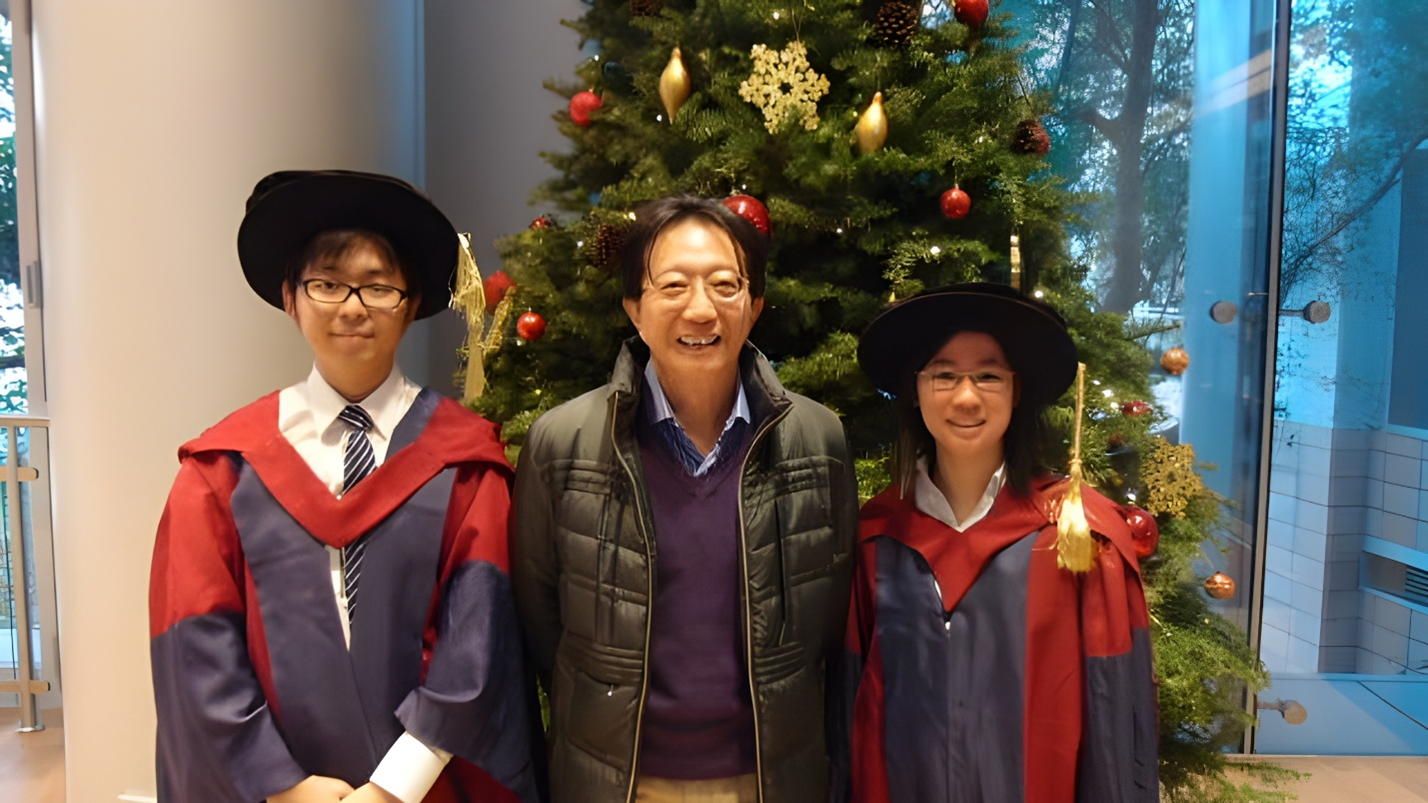
In Memory of Dr. Philip P.W. Wong by Ying Anna Pun
I met Dr. Philip Wong when I was still a student at the University of Hong Kong. At the time, I did not yet know what kind of mathematician or person I would become. But looking back now, I realize how much of who I am today was shaped by his influence, his expectations, and his quiet acts of care.
Dr. Wong was well known for being a clear and inspiring teacher. He did not sugarcoat things. He was blunt, sometimes harsh, always honest. But he was also deeply generous. I remember first taking his class in Differential Geometry, where he emphasized the importance of examples. At the time, I did not fully understand how valuable that lesson was. Years later, as I watch my own students struggle to construct their own examples, I see just how much I had learned from him, not only about mathematics, but about how to approach it with clarity and thoughtfulness.
My first research project under Dr. Wong was on Latin squares. It was a playful and exciting topic, and I remember winning the poster session and being asked to give a second-round talk. When I could not answer a question about the broader relevance of the project, he was disappointed. It stung, but it stayed with me. He wanted us to think beyond the math itself and to understand why our work mattered.
I joined his seminar group during my third year as an undergraduate and continued through my MPhil. Those weekly sessions were intense but full of energy. I still remember the setup in the math library. Dr. Wong and Prof. Siu sat on the side backing the window, and the students sat opposite them, facing the light across the long table. Dr. Wong would call on me to present at the board and then critique my explanation, often sharply. It was difficult at the time, but it shaped the way I communicate mathematics to this day. I try to give my students similar opportunities now, though I am not nearly as tough.
Once, late at night, I received an email from him, around two or three in the morning, saying he had proven a conjecture. I read it carefully, but I could not quite follow the argument. The next day he laughed and said, “When you drink whiskey and get drunk at night, you can prove anything.” That was Dr. Wong: brilliant, intense, and quietly funny.
Some of my fondest memories came after I left HKU. Whenever I returned from the United States to visit, Dr. Wong and I would always have lunch. We always ordered steamed fish, which he knew I loved and which is hard to find prepared well in the U.S. He would give me extra fish and say I needed it. Afterward, we would go for coffee and share an apple pie. Sometimes he would invite me to his apartment, and we would talk about life, about math, about whatever came to mind. Then he would drive me to the bus stop so I could head home. I always cherished those visits.
Before I left for graduate school in the U.S., Dr. Wong handed me an envelope with U.S. dollars. He did not explain much, just said it was for my use. I had not asked for anything, and I was surprised. Later, when I arrived in the U.S. and needed to secure housing, that money turned out to be exactly what I needed. As a newcomer with no credit history, I faced steep security deposits, and his unexpected gift made all the difference. It was not just help; it was care, quietly given.
He once told me, smiling, that I was the only one of his female students who had never cried. I took pride in that for many years. But now, at last, I have to admit:
You finally made me cry.
Rest well, Dr. Wong. I miss you.
A Tribute to a Beloved and Esteemed Teacher - Sharing memories from one of his students
While it is disheartening to hear about my teacher's passing, I have to say it’s my fortune and honor to be a student of Dr. Philip P.W. Wong, a cheerful mathematician and teacher. When I write as a member of his Wong's School, I thankfully recall sharing memories of his charm, enthusiasm, and vision.
The first memory comes from a class on differential geometry. In the first lesson, we were asked to write down what is the meaning of something being differentiable, that’s essentially about the existence of a linear approximation. Through this exercise, he emphasized that in doing mathematics, motivation comes before definition. I can also feel his enthusiasm in his teachings. He said when we look around and seek, we can find mathematics in our world. From the same chair in the classroom, he showed us saddle points and umbilical points. He also told us that in some special architectures we could find those doubly ruled surfaces, and in soap films we could find some minimal surfaces. The class concluded at Gauss–Bonnet theorem connecting a surface’s local geometric property, the Gaussian curvature to its global topological invariant, the Euler characteristic.
Attracted by his charm, I began auditing his weekly seminar on finite geometry during my final year of undergraduate study, which really opened my eyes. Within a year, in his School’s introduction to incidence geometry, I learned about mutually orthogonal Latin squares, the Bruck–Ryser–Chowla theorem, cyclic projective planes, cycle difference sets, quadratic extensions, and Hall’s polarities. Although I was attending without bearing credits, the content was much richer than what other usual courses could offer and touched upon various aspects of mathematics.
Later, under Dr. Wong’s supervision in graduate school, it became clearer to me that mathematics is more than the investigation of objects. It also involves studying relationships between objects, such as how coordinatization relates projective planes to ternary rings and how configurations in geometry correspond to requirements in algebraic structures. And so, following his advice and vision, I pursued my doctoral study in projective planes, configurations, unitary block designs, and their automorphism groups.
His vision transcends time. Recalling one piece of his advice, he once said that in order for the next generation to surpass him, the use of computers would be essential. I was thus encouraged to use high performance computing in research to find patterns that may be degenerated or less obvious in smaller cases. The experience turned out to be even more beneficial, in order to make effective use of computing power, an alternative definition for some non-classical projective plane was found and followed by meaningful relations. Being deeply influenced by his vision more than a decade ago, I remain optimistic in the current age of emerging AIs and think that an important motivation for having machines to ease our workload from heavy computation and reasoning is to allow humans to focus on the purity and beauty of mathematics and to cultivate an appreciation.
I must also say that I admire his leadership; he provided insight for each of his members to pursue our own paths. Everything started with a commitment. And he told me to complete tasks one by one, so that each of them would contribute to a meaningful journey in the end. He also urged me to start writing, saying that’s how wishes could come true. There was a period of time after my graduation, I had the fortune of being appointed to build and lead a team of data scientists. It was during that time that I began to understand more about those efforts Dr. Wong put into leading a team. This is so true that we cannot thank him enough.
Back in the good old days, Dr. Wong also gave valuable life advice in addition to academic guidance. He encouraged travelling when I was his graduate student. He made every trip meaningful, ensuring that each one corresponded to a milestone in research work, thereby granting each trip meaning. The first trip was to Europe, when I was just a participant, but we still engaged in discussions about mathematics along the way. Later, we had more trips to Australia and the United States, with research results announced and marked by these travels. The commitment as his doctoral student had been fulfilled by the time when that round of travelling tournament was completed around a decade ago.
To me, Dr. Wong is my cheerful teacher, warm-hearted friend, and so much more. Life is also a meaningful journey of exploration, and I should learn more from Dr. Wong’s wonderful life. May his spirit always be with us, and may he rest in peace.
Tai Yee Ka
July 27, 2025
